Unique tasks
Tasks can be deduplicated by an optional string dedupe_key. If a key is set Moab will ensure that at most one task
in ENQUEUED or IN_PROGRESS states with such a key can be present in the queue at any given time. Unique (with
non-empty dedupe_key) and regular (with empty dedupe_key) tasks can be placed into the same queue.
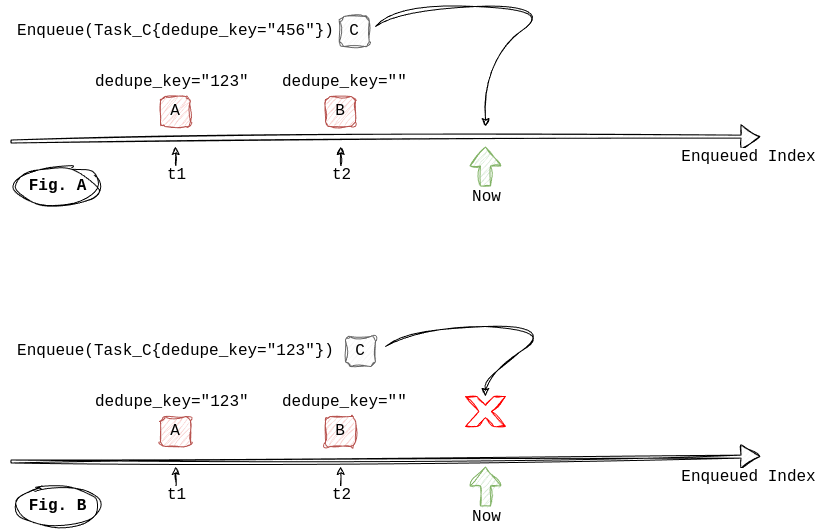
On Fig. A below, task C will be successfully enqueued because such a key does not exist yet. On Fig. B, task
C will be skipped, because such a key exists. TODO update response and return flags for skipped tasks.
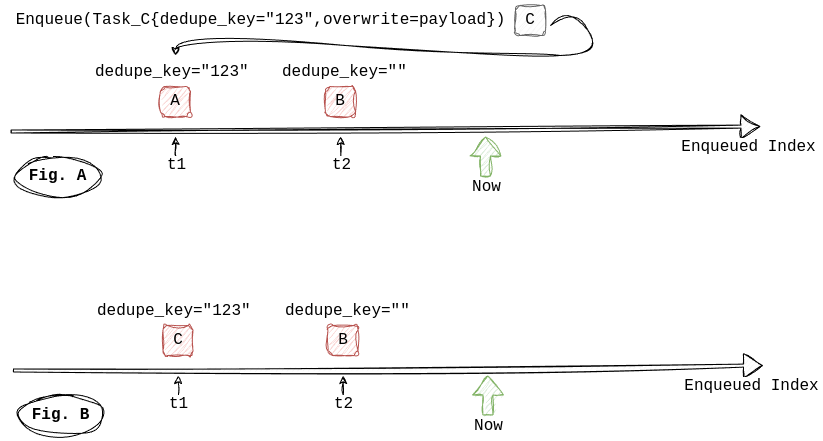
However, it is possible to overwrite one or more properties when a duplicate is being enqueued. Moab can overwrite
payload, scheduled_at, and expires_at. Figure below shows how a payload overwrite looks like.
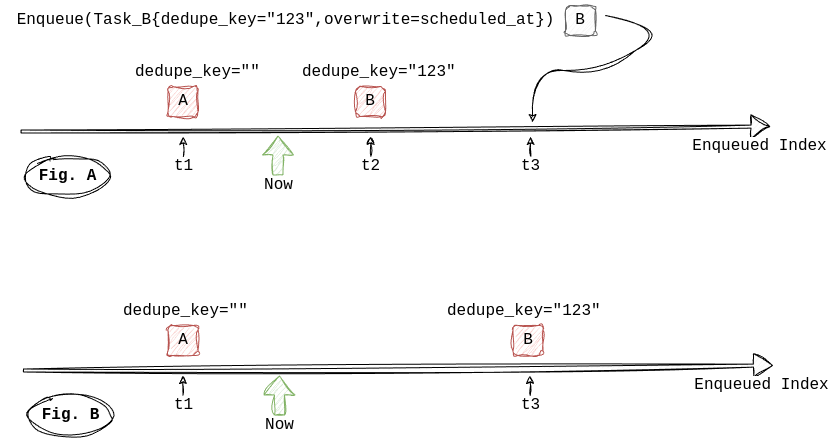
Next figure shows how scheduled_at can be overwritten. This works for both situations when a task is enqueued at now
or into the future. This is handy when something can trigger a delayed job several times, but instead of enqueuing
the same job several times it can be rescheduled instead.
Dedupe keys guard live uniqueness, not historical identity. A DedupeKey is claimed by
at most one live (ENQUEUED or IN_PROGRESS) task at a time. It is released the instant a task
stops being live — on success, on delete, and on death — so a fresh task can reuse the key
immediately after a failure. Because of that, any out-of-band resurrection of an old task under
that key (i.e. RestartTasks) must re-validate the key against current state rather than assume
it’s still free — restart is not exempt from the live-uniqueness guarantee just because it’s an
explicit operator action.