Concepts
A queue is an ordered collection of tasks. A task is a unit of work (or a message) that carries a useful
payload. A payload is opaque to Moab, it can be end-to-end encrypted if needed.
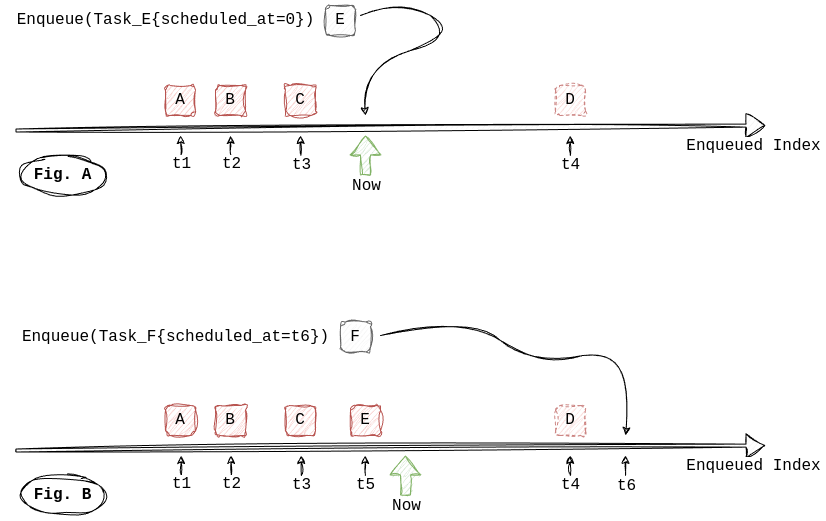
Internally, those tasks are indexed by several properties. The main index (Enqueued index) is ordered by scheduled_at
timestamp. Below, a task A is scheduled at a time t1, task B at t2 where t1 < t2, and so on:

Enqueuing
Enqueuing is adding a task to the queue. Moab queue is durable. If Enqueue returns a successful response it
guarantees all tasks have been persisted and replicated.
When enqueued, a task is in ENQUEUED state and is scheduled for now by default, meaning it is available for
processing immediately (Fig. A). A task can also be scheduled into the future (delayed) by explicitly specifying a
scheduled_at timestamp (Fig. B). If provided scheduled_at is in the past (scheduled_at < now) then it will be
replaced with now. The timestamp scheduled_at is not a unique property, several tasks can be scheduled at the same
time. Timestamp now is measured by API gateway servers, there might be drifts in time between those servers and the
client which is enqueuing a task, or between servers themselves. Because of that, there is no guarantee that two
consequent calls from the same client will enqueue tasks in exactly the same order. FIFO order is best-effort
acccounting only to any possible clock drift between API gateway servers and clients.
There is only one ordering function. A task’s position in its thread (or in the plain queue, for non-threaded tasks)
is always (ScheduledAt, TaskId), ascending. Fresh enqueues, dedupe-key ScheduledAt overwrites, retry reschedules,
and DLQ restarts are all just “a task’s ScheduledAt changed or a task newly entered the pool” — the same comparison
decides who’s next every time. There is no separate “retries go to the end” or “restarts jump the queue” rule.
Dequeuing
Dequeuing is picking up (pulling) a task from the queue. A worker is a program which periodically dequeues tasks and processes them (a consumer).
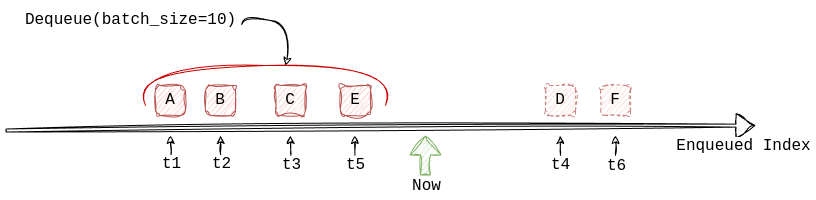
On dequeuing Moab returns only the tasks where scheduled_at <= now starting from the oldest tasks, so FIFO order is
maintained. A task can be dequeued only to a single worker and can never be delivered twice. Strictly speaking, this
is at most once delivery guarantee for each attempt.
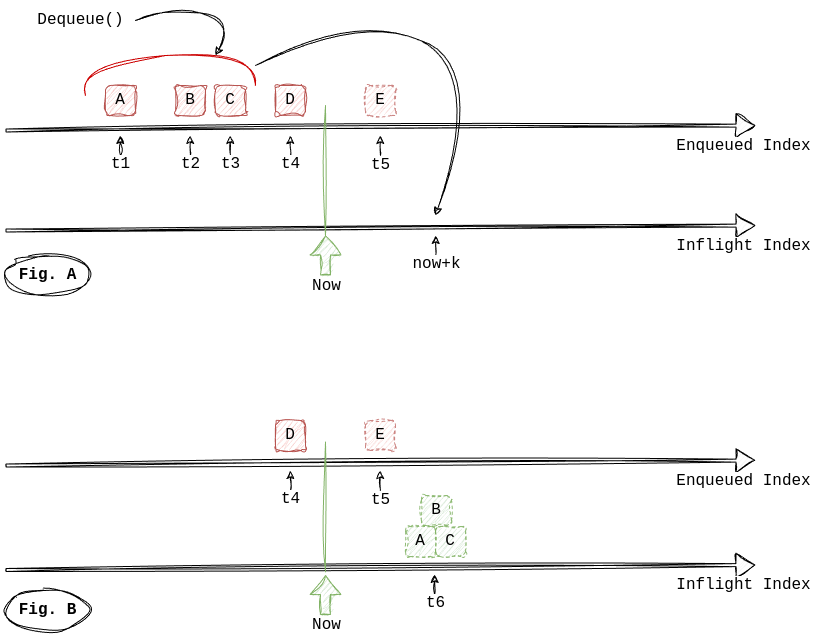
When dequeued, tasks go to IN_PROGRESS state and attempts = 1 indicates that it is picked up for the first time.
They are removed from the main index and added to InProgress index. A task is considered in-progress for
keepalive_timeout_in_seconds period, so it is placed to the InProgress index at now + keepalive_timeout_in_seconds
position. Optional keepalive_timeout_in_seconds can be set in Enqueue request for each task individually, otherwise
a default keepalive_timeout_in_seconds from the queue is used.
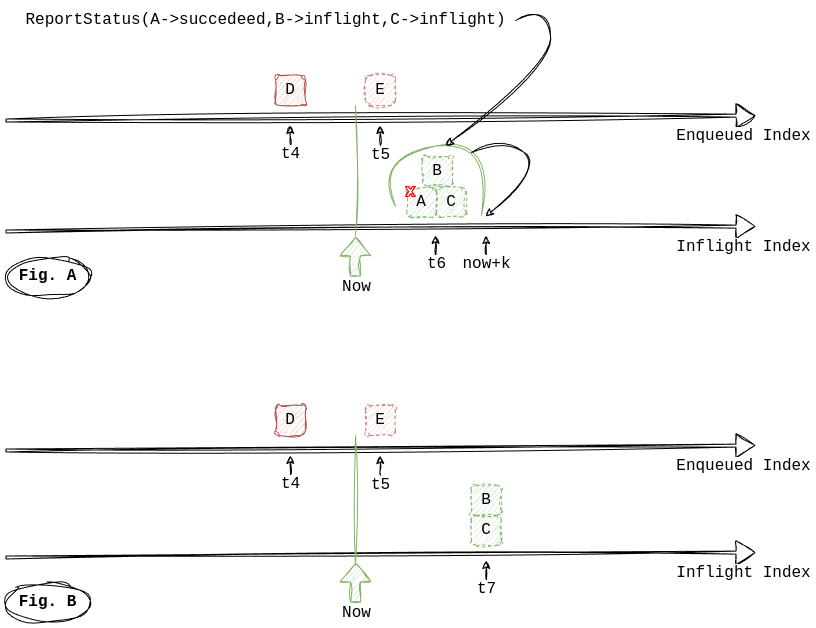
A worker must report a status of an in-progress task within this keepalive_timeout_in_seconds period. A status report
can be any of:
SUCCEEDED- the worker has successfully processed this task.IN_PROGRESS- the worker is still processing this task. There is no upper limit for long-processing tasks as long as a worker is able to report status everykeepalive_timeout_in_seconds.FAILED- there was a failure while processing this task and the worker recognized this failure.
Succeeded tasks are removed from the queue. In-progress tasks are moved in InProgress index further to the next
keepalive_timeout_in_seconds. Failed tasks are retried.
If a worker is dead or for any reason has not reported any status within given timeout a task is considered FAILED. A
task has to be explicitly reported as SUCCEEDED in order to be deleted from the queue. This makes Moab resilient to
all sorts of failures (with network or workers). See Retries section for more details.