Expiration
A task will expire if it has not been dequeued before its expiration time. Expiration time can be set with optional
parameter expires_at when enqueuing (expires_at is defined as a timestamp in the future, not a delta). By default,
all tasks will expire in expires_in_seconds retention period specified on the queue itself.
ExpiresAt is evaluated at two moment: (a) in Dequeue just before an ENQUEUED task would be handed to a worker,
and (b) just before a task that just stopped being actively worked (explicit failure, or keepalive-timeout discovery)
would be handed back to ENQUEUED or filed to DEAD. It is never evaluated while a task is genuinely IN_PROGRESS
and being renewed, and it never overrides an explicit SUCCEEDED. A background GC sweep additionally reaps ENQUEUED
and DEAD rows nobody is actively polling — but it must never touch IN_PROGRESS rows.
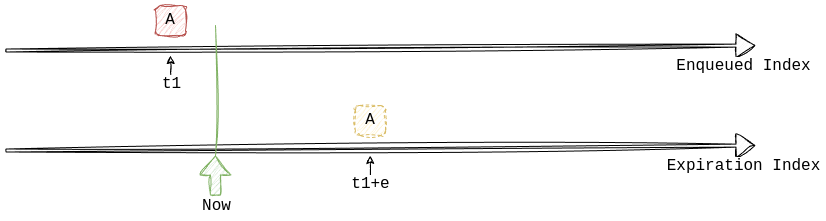
Internally, all tasks are indexed by expires_at (Expiration index). Pictured below, a task A is sheduled at t1
and will expire in e seconds (queue retention period) at moment t1 + e:
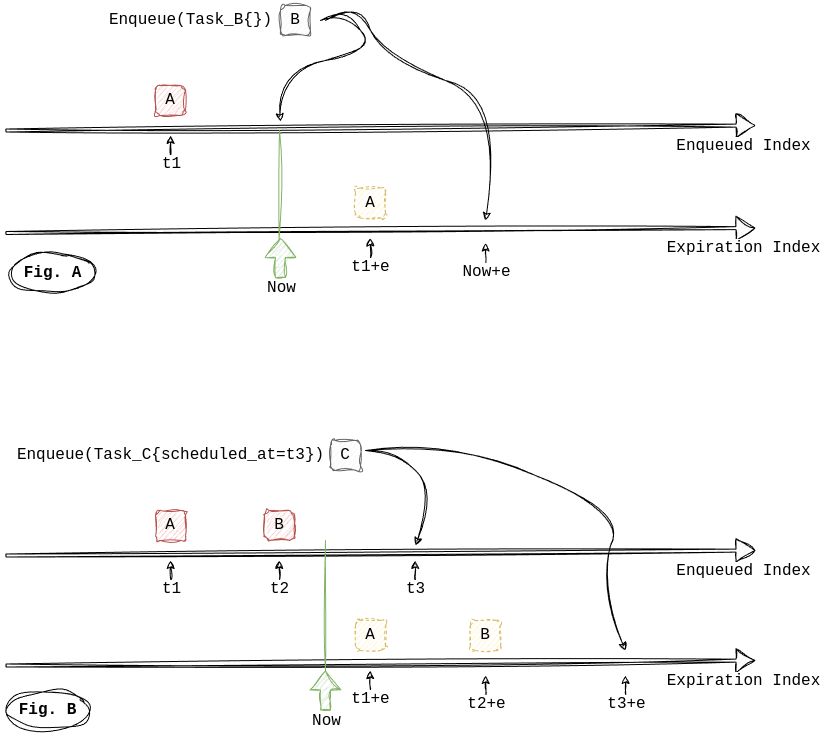
When a task is enqueued it is added to Expiration index on a default or specified expiration time, even if a task is delayed.
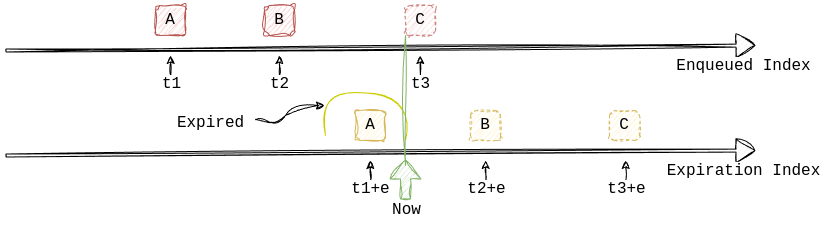
Expiration happens under the hood, tasks will be garbage collected when expires_at <= now.
There is no unlimited expiration: every task expires, and every DLQ entry expires.
queue.expires_in_secondsis required and bounded onCreateQueue/UpdateQueue. It cannot be 0, and it cannot be unbounded — “long” is fine (weeks), “forever” is not.- Whenever
dead_letter_queue_configis configured,retention_period_in_secondsis required and bounded the same way. If a caller wants a very long retention window, they ask for one explicitly, within the same ceiling. - A per-task override of either value (
enqueue_request_entry.expires_at, and theexpires_ataRestartTaskscall supplies) may be0, but0means “inherit the queue’s default,” never “no deadline.” A non-zero override that would exceed the queue’s own ceiling is clamped down to that ceiling, not rejected — consistent with howScheduledAtalready clamps up tonowrather than rejecting a past-scheduled entry (pkg/tasks/core.go’sEnqueue).
The one deliberately unbounded knob left is DeadLetterQueueConfig.max_size (0 = unlimited count) — a different
axis (how many dead rows to keep) from expiration (how long to keep any one of them), and out of scope for this law.
One deadline field, state-dependent meaning. ExpiresAt means three different things depending on state, and a task
only ever has one of them active at a time:
ENQUEUED: “don’t bother dequeuing me after this” (a delivery deadline, anchored atScheduledAt + ExpiresInSeconds, computed once at creation/restart).IN_PROGRESS: inert. Not enforced while the lease is being renewed.DEAD: “purge me from the DLQ after this” (a retention deadline, anchored atLastFailedAt + DeadLetterQueueConfig.retention_period_in_seconds, recomputed at the moment of death).